

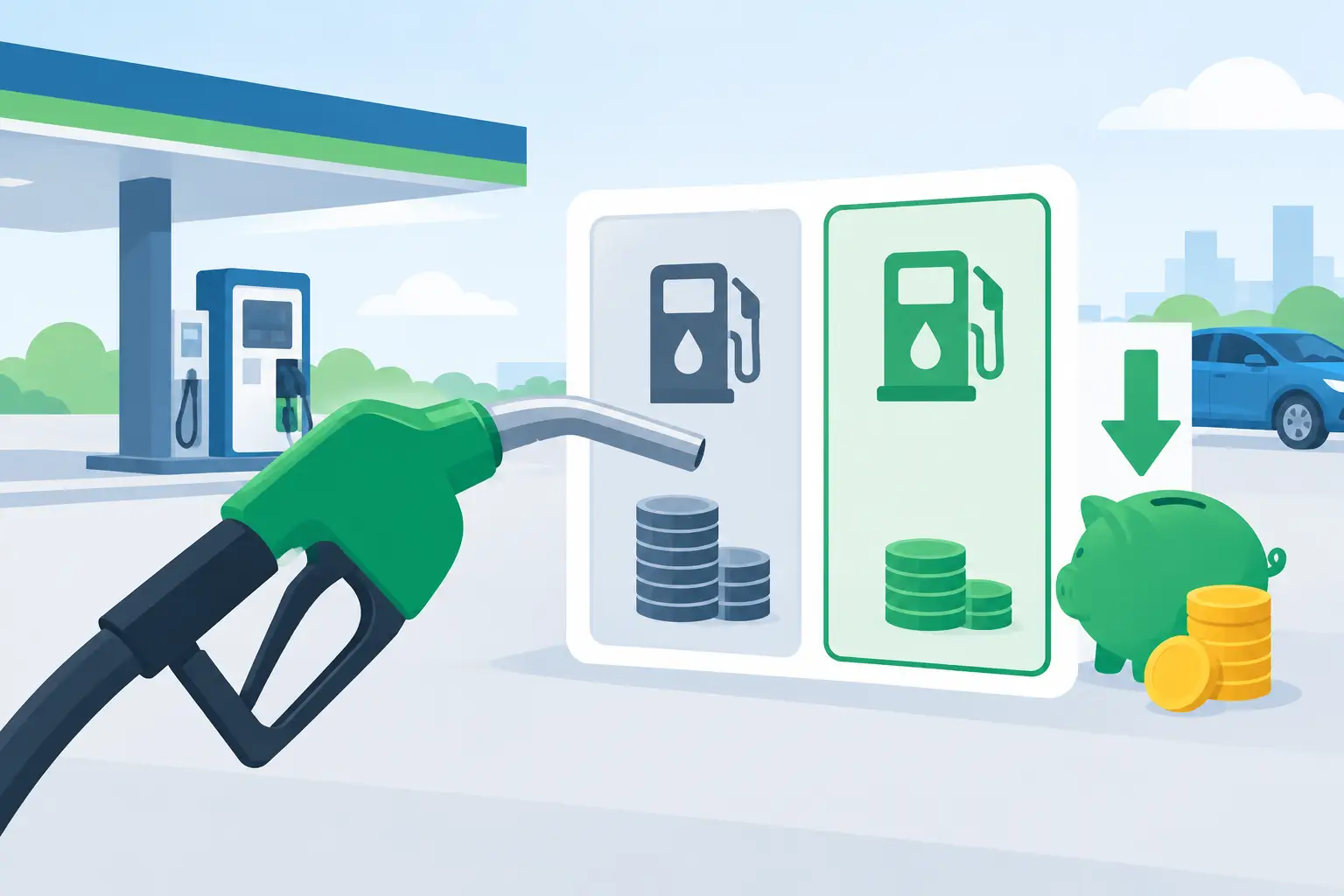
A fuel cost comparison takes less time than choosing a meal deal, yet it can protect your weekly budget from one of driving’s most changeable costs. If you buy fuel out of habit, at the first forecourt on your route or near the motorway, you may be paying more than necessary every time you fill up. Checking prices before you set off gives you a simple choice: use the station you know, or use the station offering better value.
For households balancing food shops, commuting and school runs, fuel is not an occasional expense. It is a repeat cost. That makes even small differences at the pump worth acting on.
Why a fuel cost comparison matters
Fuel prices can vary noticeably between nearby forecourts. A difference of 5p per litre costs £2.75 on a 55-litre fill. Do that twice a month and the extra spend reaches £66 over a year. At a 10p gap, the same pattern costs £132.
Those figures are not about chasing pennies for the sake of it. They show why price transparency matters. When you can see the cheaper option before you pull in, you can make a decision based on the actual price rather than convenience alone.
The best choice is not always the lowest advertised price. If the cheapest station is several miles out of your way, the detour uses fuel, time and possibly parking or congestion charges. A useful comparison considers the price per litre, the distance to the station and whether it fits a journey you already need to make.
Compare the right fuel for your vehicle
Before comparing stations, make sure you are comparing like for like. Petrol, diesel and premium fuels have different prices and different purposes. A low price on standard unleaded does not help a diesel driver, and paying extra for premium fuel is only worthwhile when your vehicle manufacturer recommends it or when you have a clear reason to choose it.
For most drivers, the practical goal is straightforward: find the cheapest suitable fuel within a sensible distance. Do not let branding, a large shop or an attractive forecourt distract from the number that affects your spend - the pence-per-litre price.
Use pence per litre, not the total bill
A larger fill naturally creates a larger receipt, but the total does not show whether you got a good price. Look at pence per litre first. It is the figure that makes each forecourt directly comparable.
Then estimate the real saving for the amount you expect to buy. Multiply the difference in pence by the litres you need, then divide by 100. For example, if one station is 7p cheaper and you need 40 litres, the saving is £2.80. That may justify a short diversion on a journey you are already making. It may not justify a separate round trip.
Build fuel price checks into your routine
The easiest savings are the ones you can repeat. Instead of checking prices only when the fuel warning light appears, make a quick comparison part of your normal planning. Check before the commute, before the weekly shop or while arranging a longer trip.
A fuel price tool is most valuable when it helps you make the decision at the right moment. PricePAL Compare is designed around this practical need: check fuel prices near you, compare the options and choose the cheaper stop without turning it into a lengthy task.
If you often travel the same routes, you will soon spot useful patterns. One area may regularly offer better prices than another. A supermarket forecourt may be competitive on a particular shopping day, while an independent station on your commute may be better on another. Prices move, so habits should be informed by current information rather than old assumptions.
Plan around journeys you are already making
Fuel comparison works best when it is tied to an existing trip. Fill up near the supermarket, on the way to work or before joining a major road, rather than driving across town purely for a lower sign price.
This matters because a saving can disappear quickly. Suppose a station is 4p per litre cheaper and you plan to buy 30 litres. That saves £1.20. If reaching it adds unnecessary mileage, traffic and time, it may not be the better option. The target is a lower overall cost, not simply the lowest number on a map.
Avoid the emergency fill-up premium
Running close to empty narrows your choices. When the warning light is on and you are pressed for time, you are far more likely to accept the next available price. Keeping enough fuel for an extra day or two gives you room to compare and choose.
This does not mean filling the tank at every opportunity. Carrying a completely full tank adds a little weight, and it may not suit every journey or budget. It means avoiding the point where urgency takes control of the decision.
How to judge whether a detour is worth it
Use a simple rule: calculate the saving at the pump, then compare it with the likely cost of getting there. You do not need a perfect calculation. A sensible estimate is enough to stop a false saving.
Consider four questions before changing your route:
- How many litres will you actually buy?
- What is the price difference per litre?
- Is the station on, or close to, a journey you already have planned?
- Will extra mileage, traffic or time cancel out the benefit?
For a small top-up, convenience often wins. For a near-empty tank, a family car or a regular van route, a price gap of several pence per litre can be meaningful. The key is matching the effort to the likely saving.
Fuel savings are stronger when paired with smarter shopping
For many households, fuel and groceries are bought on the same day. That creates a useful opportunity: compare both costs before leaving home. Choosing a cheaper fuel stop and finding lower-priced essentials can reduce the total cost of the trip without adding extra errands.
This is where repeat savings matter more than one-off deals. Saving £2 on fuel and £5 on a weekly shop may not feel dramatic in isolation. Repeated over 52 weeks, that is £364 kept for bills, savings, debt repayments or the things your household actually needs.
Be careful not to spend more in-store simply because the fuel price is good. A cheap forecourt attached to an expensive convenience shop can still raise the cost of your stop if you pick up high-priced essentials. Plan your shopping, compare grocery prices where possible and treat the fuel saving as one part of the total decision.
Common mistakes that make fuel cost more
The first mistake is assuming every supermarket forecourt is automatically cheapest. They can be competitive, but local prices still vary. Check rather than guess.
The second is comparing prices too late. If you wait until you are already on the forecourt, the useful choice has gone. A quick check before you leave gives you options.
The third is focusing only on headline prices while ignoring the fuel grade. Make sure the lower price is for the fuel your vehicle needs.
Finally, do not confuse loyalty with value. Points schemes, vouchers and familiar brands can have value, but they should not hide a larger difference in the price per litre. Work out the cash saving first, then decide whether any reward changes the result.
Make every fill-up a more informed decision
You do not need to predict fuel prices or change your whole routine. Start with one habit: check local prices before your next planned fill-up. Choose a suitable station that fits your route, keep an eye on pence per litre and avoid leaving the decision until the tank is nearly empty.
The money saved at one pump may be modest. The control you gain by making the same better decision week after week is what makes the difference.