


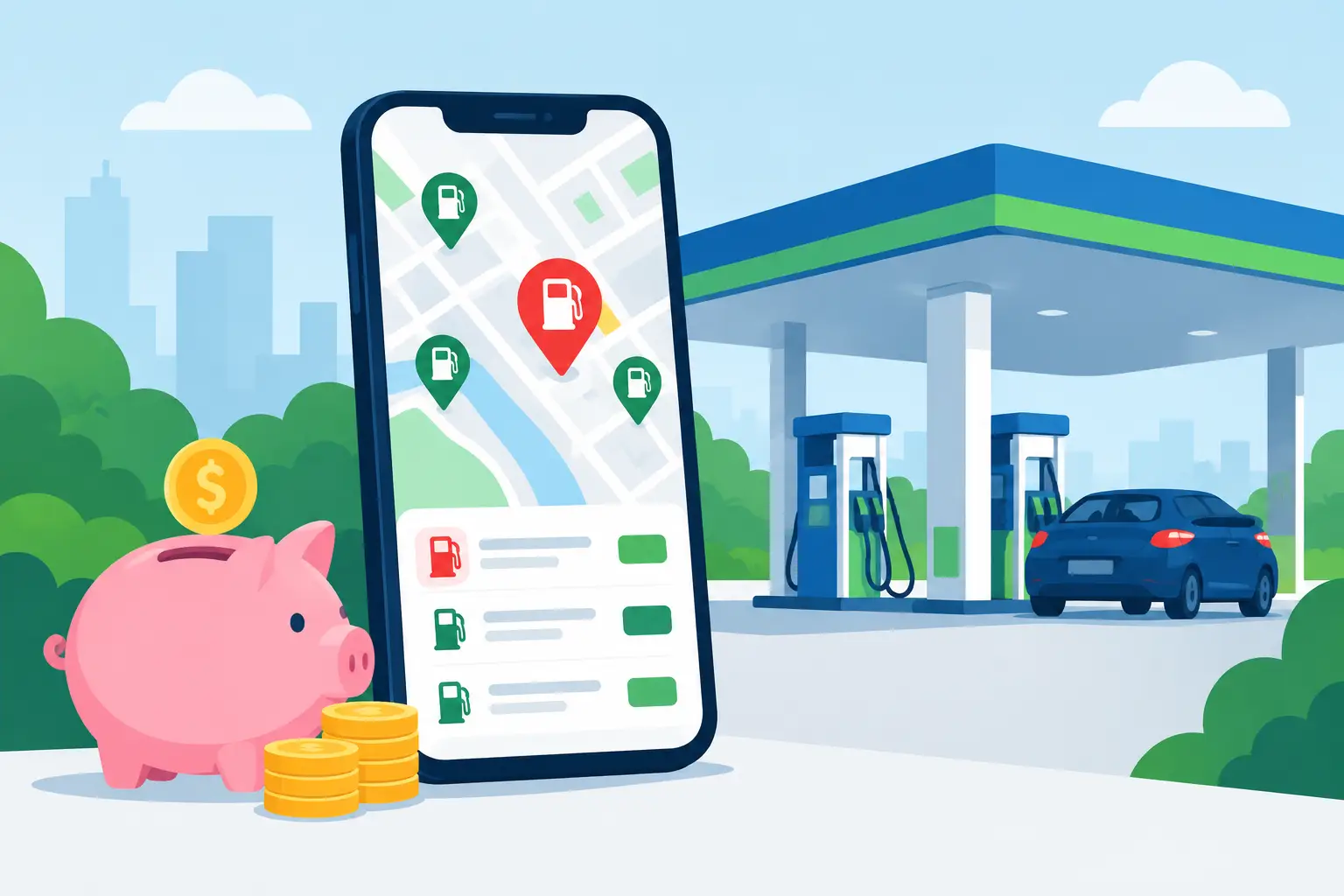
A difference of a few pence per litre can look small on a forecourt sign. Across a full tank, a weekly commute and a year of driving, it becomes money that never needed to leave your household budget. Petrol finder apps give UK drivers a quick way to compare nearby prices before choosing where to fill up.
The aim is not to chase every last penny with a cross-town detour. It is to make a better decision on the journeys you are already making: on the way to work, after the weekly food shop or before a longer trip. Used properly, these apps turn a routine expense into one you can control.
What petrol finder apps actually do
Petrol finder apps show fuel prices at nearby filling stations, usually separated by fuel type such as unleaded, diesel and premium grades. Many let you search by postcode, view stations on a map and sort results by price or distance. That removes the guesswork from deciding whether the station at the end of your road is genuinely competitive.
For drivers watching household costs, the value is speed. Instead of noticing a price only after you have pulled onto the forecourt, you can check likely options first. A useful app should help you see the price per litre, how recently it was updated and where the station sits in relation to your route.
Price information is only as useful as its timing. Fuel prices can change, and some services rely on updates that may not be immediate. Treat the displayed price as a strong guide, then check the pump before filling up if the difference is significant. This is still far better than choosing blindly.
How to use petrol finder apps for lower fuel costs
Start with the fuel you actually use. Selecting the wrong grade makes every comparison meaningless, particularly when petrol, diesel and premium fuels are listed together. Check your vehicle handbook if you are unsure whether it needs E10, super unleaded or a particular diesel specification.
Next, search around places you will already visit. Your home postcode is useful, but it is not the only one that matters. Check near your workplace, supermarket, school run or regular main-road route. A lower-priced station that adds ten minutes and several miles to your trip may cost more overall than a slightly dearer option you pass anyway.
When comparing results, look at three things together: the pump price, the distance and the update time. The cheapest listed price is not automatically your best choice if it is far away or the information is old. A practical saving is one you can make without spending extra fuel and time to get it.
It also helps to check prices before your tank is close to empty. Waiting until the warning light comes on reduces your options and can force you to pay whatever is closest. A quick check when you still have enough fuel for a few days gives you room to choose a cheaper stop on a planned journey.
Compare the whole trip, not just the price per litre
Fuel pricing is designed to make small differences easy to overlook. On a 50-litre fill, a 5p-per-litre gap equals £2.50. If you fill up twice a month, that is about £60 over a year. The saving grows when you avoid consistently expensive locations rather than trying to predict the perfect day to buy.
But the maths changes when a cheap station is out of the way. A detour uses fuel, adds wear to the car and takes time. If travelling there and back costs nearly as much as you save at the pump, choose the competitive station on your normal route instead.
This matters especially around motorway services, airports and busy commuter routes, where convenience can carry a premium. There are times when paying more is sensible: you may be low on fuel, travelling with children or heading to an appointment. Petrol finder apps are not about making every journey complicated. They are about knowing when you have a real choice.
A quick way to judge a worthwhile stop
Work out the likely saving on the amount you expect to buy, rather than comparing prices in isolation. If one station is 4p per litre cheaper and you plan to buy 40 litres, the saving is £1.60. Then ask whether the extra journey is effectively free because you are already passing it. If yes, take the lower price. If not, the convenience of a nearby competitive station may be worth more.
This approach keeps fuel comparison useful rather than obsessive. You do not need to drive around searching for the cheapest pump in the county. You need a reliable view of the best options within your everyday routine.
Make price checks part of your weekly routine
The most effective users do not wait for a crisis at the pump. They check fuel prices alongside other regular spending decisions, such as planning the food shop or reviewing the week’s journeys. It takes little time, and it prevents expensive last-minute choices.
For example, if you normally shop on Saturday and fill up on Sunday, compare local prices before leaving home. If the supermarket forecourt is competitive, combine both jobs. If a nearby independent station is cheaper and sits on your route, use that instead. Repeating this simple habit can produce steadier savings than reacting to occasional promotions.
PricePAL Compare is built around this kind of practical comparison: check grocery costs, find cheaper fuel options and keep more control over the spending that repeats every week. The important point is consistency. One smart fill-up is helpful; a better decision each time you need fuel has a larger effect on your budget.
Set a sensible refill point
Choose a personal refill point that leaves enough fuel to compare rather than panic-buy. For some drivers, that may be when the gauge reaches a quarter of a tank. Others may prefer to check every Sunday or before a known long journey. The best approach depends on mileage, local station choice and how predictable your week is.
Avoid filling the tank automatically if you only need enough fuel to reach a cheaper option you will pass in the next day or two. Equally, do not run so low that you turn a small saving into an unnecessary risk. The goal is flexibility, not stretching every litre to the limit.
Look beyond branded assumptions
Many drivers assume one brand will always be cheaper or that supermarket fuel will always offer the best value. Prices vary by location, local competition, delivery costs and demand. A station that is usually inexpensive can be dearer on a particular day, while a competitor nearby may have reduced its price.
That is why current comparisons beat assumptions. Use the app to assess the stations near you, then build a short mental list of reliable options. Over time, you will know which forecourts are regularly competitive and which ones tend to charge for convenience.
If you use a loyalty scheme, include its realistic value in your thinking, but do not let points disguise a higher pump price. A small reward may not offset paying several pence more per litre. Compare the cash cost first, then treat points as an extra benefit where the underlying price is already reasonable.
Get the most from the information available
Petrol finder apps work best when you use them as a decision tool, not a promise that every displayed price will be unchanged at the pump. Check the update time, keep an eye on fuel grade and factor in your route. If a price looks unusually low or the information appears old, have a second nearby option in mind.
For families and commuters, the biggest opportunity is often not a dramatic one-off discount. It is avoiding the higher-priced forecourts that quietly add to monthly costs. Compare before you travel, fill up where it makes sense and put those small savings back towards the costs that matter at home.