

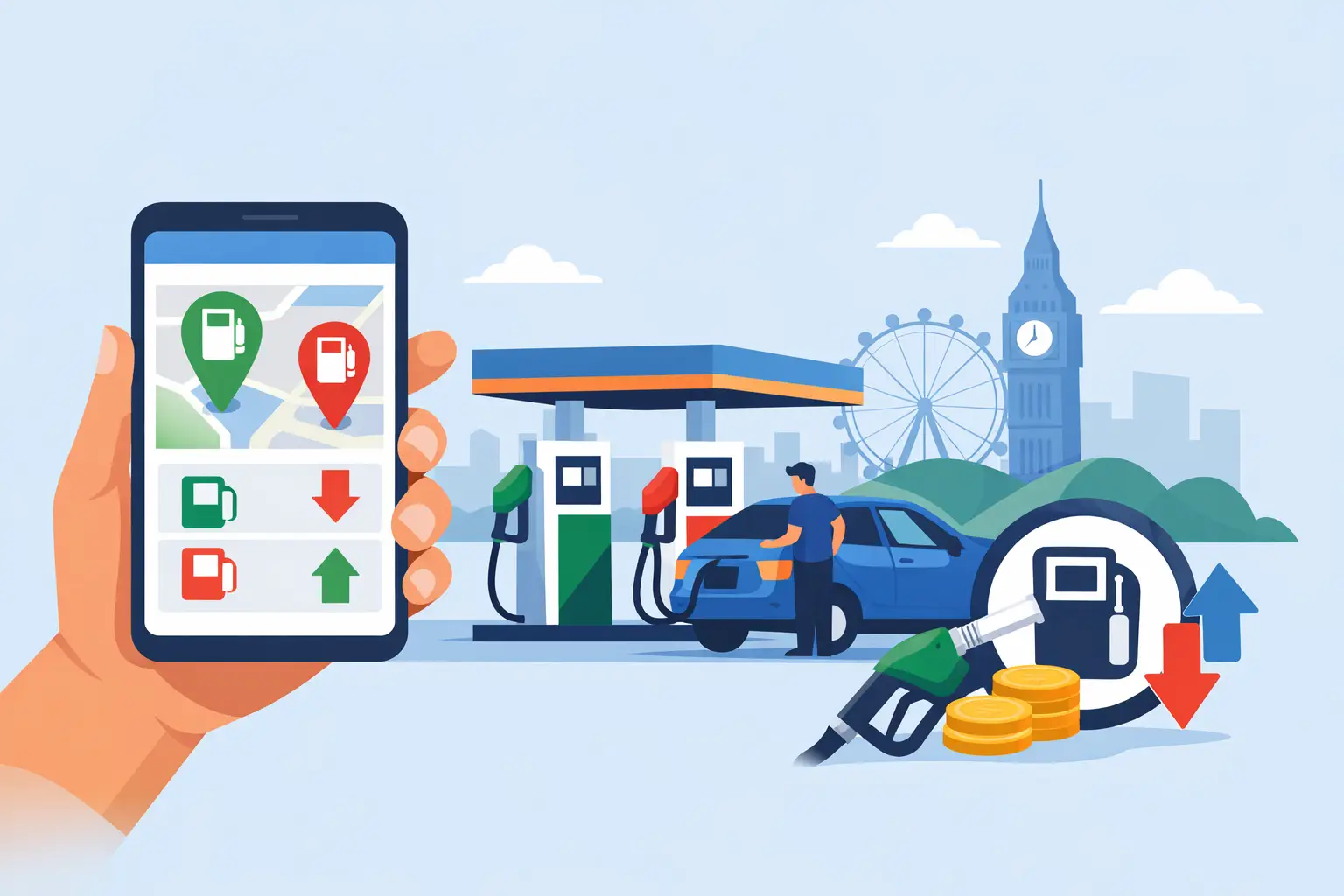
A petrol price comparison app UK drivers can use before setting off can turn a routine fill-up into an easy saving. A few pence per litre does not sound dramatic at the pump, but across a full tank, regular commuting and the family car, it quickly becomes money that could stay in your weekly budget.
Fuel is one of those costs that is hard to avoid and easy to overpay for. Prices can differ between stations only a few miles apart, while supermarket forecourts, independent sites and motorway services can all charge very different amounts. Checking prices before you commit gives you a straightforward choice: pay the first price you see, or find a better one nearby.
Why petrol prices vary so much
There is no single price for petrol across the UK. Forecourts set their own retail prices, reacting to wholesale costs, local competition, operating costs and where the station is located. A station on a busy motorway route may charge more because drivers have fewer alternatives. A station close to several competitors may need to keep its price lower to win custom.
That means the cheapest station is not always the nearest one, and the most convenient station is not automatically the best value. The gap can be especially frustrating when you fill up without checking, then pass a cheaper forecourt later in the same journey.
The aim is not to chase a tiny saving at any cost. It is to make a quick, informed decision before a regular purchase. If a cheaper station is on your route to work, the supermarket or the school run, the saving is useful. If reaching it means a long detour, extra fuel and extra time, the cheaper price may not be worth it.
What a petrol price comparison app in the UK should show
A useful fuel comparison tool should make the decision simple. You need to see nearby stations, their current petrol and diesel prices, and enough location detail to judge whether a stop fits your journey. A map view helps when you are travelling somewhere unfamiliar, while a list can be quicker when you simply want the lowest local price.
Price freshness matters. Fuel prices move, and an old price can lead to a wasted trip or an unpleasant surprise at the pump. Check when information was last updated where that detail is available, and treat the displayed price as a guide to compare before you leave. If a price looks unusually low or high, it is sensible to confirm it on arrival.
The best app experience is about more than finding the lowest number. It should help you compare the price against distance and convenience. Saving 4p per litre on a 50-litre fill saves £2. But driving ten miles out of your way just to get it can wipe out the benefit, particularly if traffic turns a short diversion into a slow journey.
Compare the cost of a full tank, not just the pump price
Pence-per-litre pricing can make differences feel small. Convert the difference into pounds and the choice becomes clearer.
If one local station charges 142.9p per litre and another charges 149.9p, the difference is 7p per litre. On a 45-litre fill, that is £3.15. For a driver filling up weekly, choosing the lower-priced option when it is conveniently located could save more than £150 across a year.
Your actual saving depends on how much fuel you buy, how often you drive and whether the cheaper forecourt fits naturally into your plans. Drivers covering high weekly mileage may see a bigger benefit from checking prices regularly. For low-mileage drivers, a comparison is still worthwhile when the tank is running low, but there is less reason to make a special trip.
It also helps to avoid topping up with small amounts just because you spot a low price. Filling early may be sensible if you are already nearby, but driving to a cheap station with plenty left in the tank is not always the money-saving move. Use a comparison app to plan the next practical fill rather than turning fuel shopping into another errand.
Build fuel comparison into your normal routine
The simplest habit is to compare prices when you already know you will need fuel soon. Check before the weekly food shop, before a longer drive or when the fuel warning light is likely to come on within the next few days. This gives you options without putting yourself under pressure to stop at the nearest forecourt.
For commuters, compare stations along the usual route rather than only around home. A lower-priced station near work, close to a regular supermarket or just off the normal route may be more useful than the lowest price in your postcode. The best saving is usually the one you can repeat with no extra hassle.
Families can make this part of the wider weekly shopping plan. Grocery promotions, own-brand swaps and fuel prices all affect the same household budget. PricePAL Compare is designed around that practical reality: compare essential costs before you spend, so small decisions add up across the week.
Try setting a personal rule that works for your driving pattern. For example, you might check prices whenever the gauge reaches a quarter of a tank, or before any journey of more than an hour. A regular trigger is easier to keep than relying on memory when you are busy.
Petrol, diesel and premium fuel: compare like for like
Make sure you are comparing the right fuel grade. Standard unleaded petrol and diesel are the relevant prices for most drivers, but premium fuels are often priced separately. A premium option may suit a particular vehicle or driver preference, yet it should not be compared directly with standard unleaded as though they are the same product.
Your vehicle handbook should guide the fuel specification you need. Do not choose a lower-priced fuel if it does not meet the manufacturer’s requirements. The saving from a cheaper litre is never worth risking avoidable engine problems.
Electric vehicle drivers face a similar comparison challenge, although charging is priced differently. The useful principle is the same: compare the total cost, the location and the convenience before committing. For petrol and diesel drivers, that starts with knowing the current local price rather than guessing.
Avoid the common ways fuel savings disappear
A low displayed price can tempt drivers into decisions that cost more overall. Keep these practical checks in mind before changing route:
- Consider the round-trip distance, not just the distance from where you are now.
- Factor in congestion, parking or queuing if the station is in a busy area.
- Compare the price for the fuel you actually use, including the correct grade.
- Avoid making a separate journey solely for a modest saving unless you need to travel that way anyway.
- Check whether a supermarket fuel stop can be combined with a grocery shop you already planned.
There is also a trade-off between filling completely and only buying what you need. A full tank can reduce the number of forecourt visits, but it adds weight to the vehicle. For most everyday drivers, the difference is unlikely to outweigh the convenience of fewer stops. The more useful decision is choosing a competitively priced station on a journey you already need to make.
Turn a quick check into repeat weekly savings
Fuel prices are not something you need to track all day. A short comparison at the right moment is enough to avoid paying more than necessary. Check nearby prices, look at your planned route, calculate the likely saving on your usual fill and choose the option that makes sense for your time as well as your wallet.
A petrol price comparison app is most valuable when it becomes a normal part of spending decisions, not a last-minute search when the tank is nearly empty. Check before the next fill-up, choose the cheaper practical option and keep that saving available for the costs that matter at home.